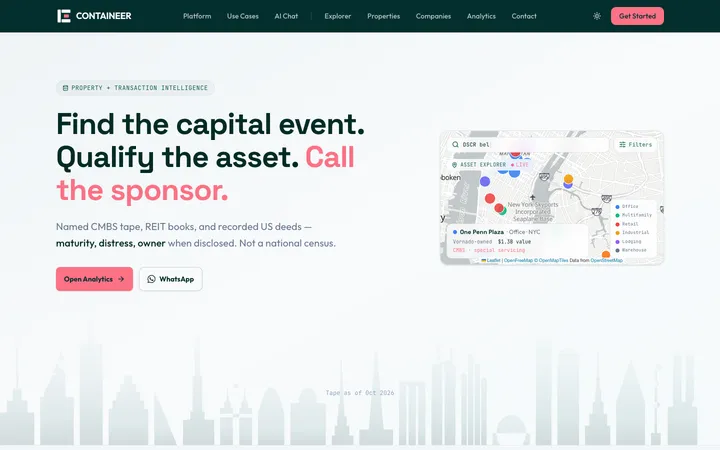

Containeer
Businesses · B2BAI intelligence for commercial real estate and private credit: ownership, debt and distress, decoded.
Brickeer · Data and AI in production
We build data platforms, AI agents and models alongside your team. And we don't leave until they can run them without calling us.
Client work
We built them with Containeer and Northa, and they are still running. You won't find their marketing numbers here, just the product as people use it.
AI intelligence for commercial real estate and private credit: ownership, debt and distress, decoded.
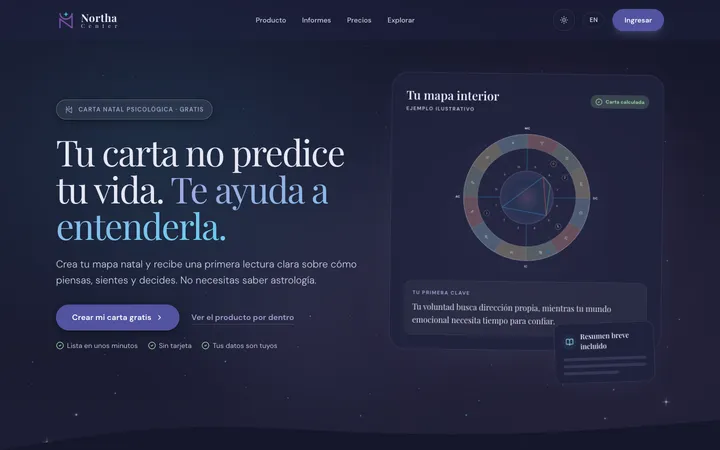

Psychological astrology, AI and certified professional support for your self-knowledge.
Working in the public sector? Same method, with one more requirement: every decision the system makes has to be explainable.
See all client work →How we work
So from day one we sit with the people who will use it and show them every step before moving on.
We talk about what your business needs. The tool gets picked later.
Before proposing anything, we understand how you work and what data you have.
Data and AI projects tend to fail in the same places. We watch them from the start.
Delivery is one more milestone. We stay until your team runs it on its own.
In practice: There at every milestone
You talk directly to the people building it. If a risk shows up, we tell you as soon as we see it.
In practice: A direct line to the team
Every so often we show you something that works and decide together what comes next.
In practice: A demo at the end of each cycle
Code and documentation your team can read and change without depending on us.
In practice: A system your team runs
Builds the system and leaves it running in your cloud.
Turns your goal into priorities and a way to measure whether it worked.
Thinks about who will use it and how it helps you sell more or spend less.
What we build
Three practices that support each other. The diagrams you'll see are illustrations.
One concrete task, its tools and a person where the answer matters: classifying, searching documents or leaving a draft ready to review.

Airflow, Dagster, or ADF hold the schedule, the retries, and the alert when something fails. The pipeline can be started again without opening the laptop of the person who wrote it.
A sample pipeline
✓ All goodBrings the data in from its source.
Checks that the data has the expected shape.
Removes duplicates and errors.
Turns it into tables that can be queried.
Leaves the result ready for your team to use.
Each step can be run again on its own.
Databricks, BigQuery or Snowflake, with the data on S3 or R2, depending on the account you already use. Spark provides the engine when you need to process at scale. The data stays where it already is.
Your platform, in your cloud
The data lives in your own buckets. It is yours and it can move.
AWS S3 · Google Cloud Storage · Cloudflare R2
Open formats from start to finish, without tying you to a vendor.
AI + people
We use AI for the repetitive parts: classifying, searching, writing the first draft. Whatever gets approved is approved by a person.
Use case
Building a data architecture, brick by brick
Builds the dashboards and the alerts.
Decides what is measured and what to do about it.
Illustrative case. AI proposes; a person decides.
An illustrative, summarized case. Decisions are always made by a person.
Start to finish
Initiation, plan, execution, control and close. In «Method» you see who does what in each phase and what you get.
A sponsor as first contact, the decision that has to improve and a success criterion. If any of them is not clear yet, we define it together before starting.
Let's talk
Tell us what you want to achieve. If it is not all defined yet, we will work it out together.
No formal brief needed. Tell us what you want to achieve and what you have today, and we'll work out together how to shape it.
The form opens your mail program. There is no inbox on this site: you send the message yourself to info@brickeer.com.
It's read by the people who would build it.